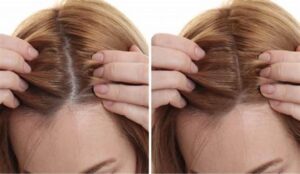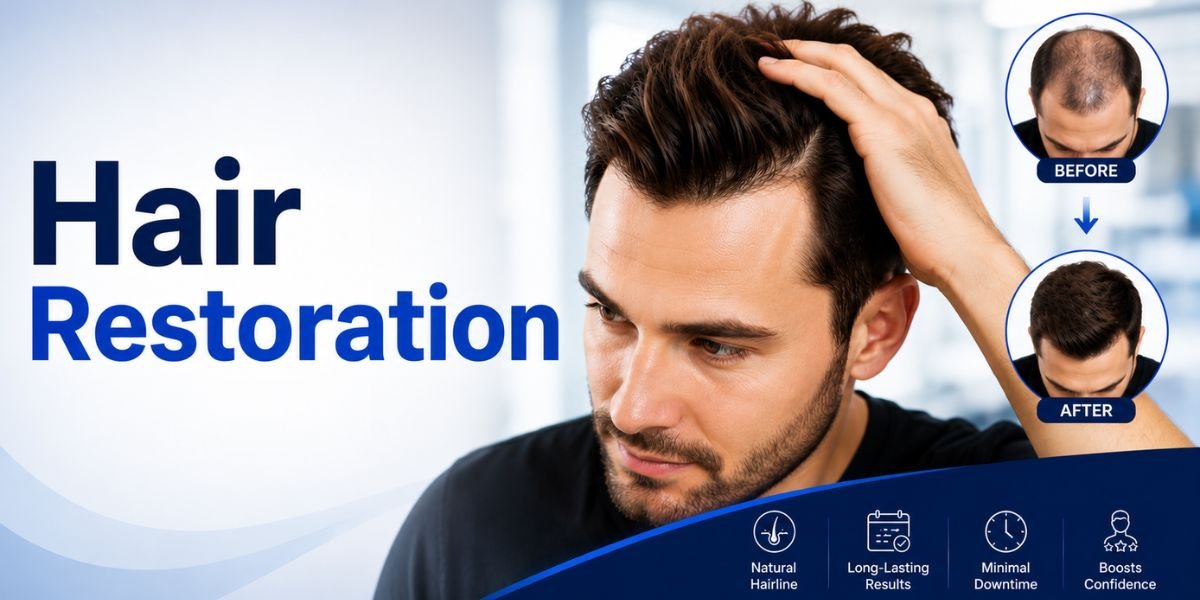
Hair Restoration has become an increasingly popular option for people dealing with thinning hair, receding hairlines, bald spots and pattern hair loss. Modern Hair Restoration can include medications, platelet-rich plasma (PRP), low-level laser therapy and surgical hair transplantation. The right treatment depends on the cause of hair loss, the condition of the scalp, the amount of donor hair available, age, medical history and personal goals.
Hair loss does not always require a hair transplant. The American Academy of Dermatology recommends identifying the cause of hair loss before choosing treatment because different types of hair loss require different approaches. Early diagnosis can also improve the chances of preserving existing hair.
For people considering Hair Restoration in the USA, cost is another major consideration. Hair transplant prices can range from several thousand dollars to well above $10,000 depending on the number of grafts, technique, surgeon, clinic location and complexity of treatment. A recent 2026 cost guide reports a US hair transplant range of approximately $3,919 to $10,640, although individual quotes can be considerably higher or lower.
This guide explains the main Hair Restoration treatments, typical costs, expected results, recovery, possible risks and the most important factors to consider when choosing a hair restoration clinic.
What Is Hair Restoration?
Hair Restoration is a broad term used for treatments designed to reduce hair loss, preserve existing hair or replace hair in areas where it has become thin or absent. Some treatments stimulate existing follicles, while surgical transplantation moves healthy follicles from a donor area to areas affected by hair loss.
Hair Restoration can be appropriate for both men and women, although the pattern and cause of hair loss can be different. Male pattern hair loss commonly affects the hairline, temples and crown, while female pattern hair loss often causes more widespread thinning across the top of the scalp.
The most appropriate Hair Restoration treatment should be selected after evaluating why the hair is thinning. Genetic hair loss, hormonal changes, nutritional deficiencies, certain medications, autoimmune conditions, scalp disorders and temporary shedding can require very different treatment plans.
Common Hair Restoration Treatments
There is no single Hair Restoration treatment that works for everyone. Depending on the diagnosis, a dermatologist or qualified hair restoration specialist may recommend medication, non-surgical procedures, transplantation or a combination of treatments.
Minoxidil
Minoxidil is one of the best-known medications used for Hair Restoration. It is available as a topical treatment and can help reduce hair loss, stimulate hair growth and strengthen existing hair in some people.
The American Academy of Dermatology states that minoxidil can help with early hair loss, but it cannot regrow an entire head of hair. Results generally take time, with many people needing approximately six to 12 months to evaluate the response. Continued use is generally necessary to maintain the benefit.
Topical minoxidil is available without a prescription in the USA. Possible side effects can include scalp irritation, itching and headaches. People should follow product directions and discuss treatment with a healthcare professional when appropriate.
Finasteride
Finasteride is a prescription medication used for male pattern hair loss and is another important option in Hair Restoration. It can slow further hair loss and may stimulate some regrowth, particularly when treatment begins relatively early.
The AAD reports that finasteride can slow further hair loss in many men and that noticeable improvement may take several months. Treatment generally needs to continue to maintain the benefits.
Finasteride can cause side effects, including sexual side effects and mood-related effects in some people. It is not appropriate for everyone. Women who are pregnant or may become pregnant should not take finasteride because of the potential risk to a developing male foetus.
A healthcare professional should determine whether finasteride is appropriate for an individual patient.
Platelet-Rich Plasma Therapy
PRP is a non-surgical Hair Restoration treatment that uses a patient's own blood. A small blood sample is processed to concentrate platelets, and the resulting plasma is injected into areas affected by hair thinning.
The AAD notes that studies indicate PRP can be a safe and effective treatment for some types of hair loss. Treatment commonly involves a series of sessions followed by maintenance treatments.
PRP does not create a new supply of donor hair in the same way as a transplant. Its goal is generally to support existing follicles and improve hair density or reduce shedding in appropriate patients.
Low-Level Laser Therapy
Low-level laser therapy, sometimes called low-level light therapy, is another non-surgical Hair Restoration option. It uses specific wavelengths of light to target the scalp.
The AAD reports that some studies suggest laser therapy may help hereditary hair loss, although multiple sessions are generally needed and results can vary.
Laser devices may be available for home use, while other treatments are performed in a clinical setting. Patients should understand the difference between FDA-cleared and FDA-approved claims when evaluating hair-loss devices.
Hair Transplantation
A hair transplant is a surgical form of Hair Restoration that moves healthy hair follicles from a donor area, usually the back or sides of the scalp, into areas affected by hair loss.
Modern transplantation uses individual follicular units rather than the older “hair plug” appearance associated with outdated procedures. When appropriately planned and performed, transplantation can produce natural-looking and long-lasting results.
A hair transplant is not suitable for every person. A patient needs an adequate supply of healthy donor hair, and the underlying type of hair loss must be appropriate for transplantation.
FUE vs FUT Hair Transplant
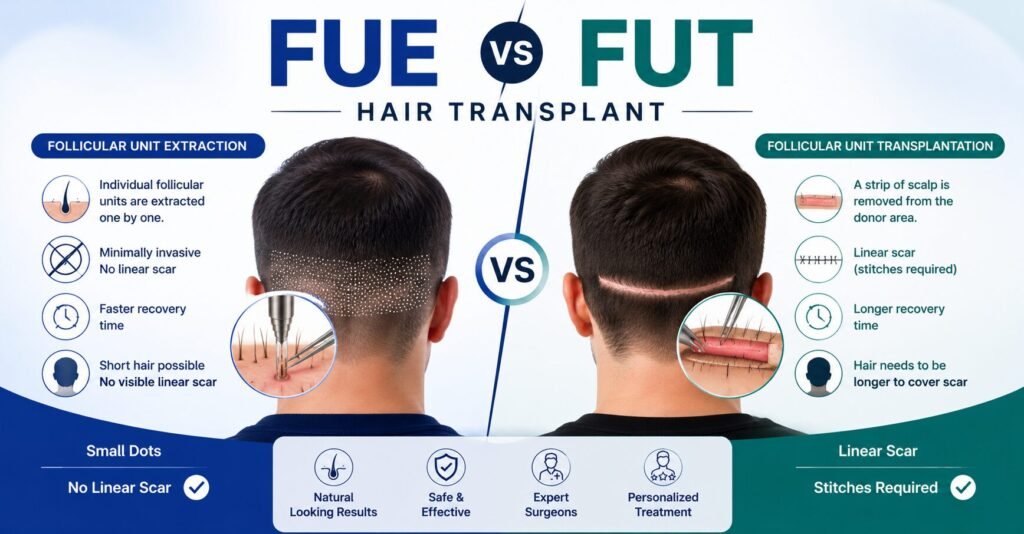
When researching surgical Hair Restoration, you will commonly encounter two techniques: FUE and FUT.
Follicular Unit Extraction
FUE, often referred to as follicular unit excision, involves removing individual follicular units from the donor area and transplanting them into areas where hair is thinning.
FUE does not require removing a long strip of scalp tissue. Instead, follicles are harvested individually. Because the process can be labour-intensive, FUE may cost more than FUT in some clinics.
One potential advantage of FUE is that it generally leaves small individual extraction scars rather than the linear scar associated with traditional strip harvesting.
Follicular Unit Transplantation
FUT involves removing a strip of scalp from the donor area and separating it into individual follicular units for transplantation.
FUT can allow a surgeon to harvest a substantial number of grafts efficiently, but it leaves a linear scar in the donor area.
Neither FUE nor FUT is automatically the best Hair Restoration technique for every patient. The decision depends on donor density, hair characteristics, the number of grafts needed, previous surgery, hairstyle preferences and the surgeon's assessment.
Hair Restoration Cost in the USA
The cost of Hair Restoration in the USA varies significantly between patients and clinics. A recent 2026 US cost guide places the national hair transplant range at approximately $3,919 to $10,640, but actual prices can vary considerably.
Some patients may receive quotes below this range, while complex procedures with large numbers of grafts or highly experienced surgeons can cost substantially more. Patient-reported data from RealSelf, for example, show an average reported hair transplant cost of approximately $10,153, with some patients reporting costs above $20,000.
These figures should be viewed as general reference points rather than guaranteed prices.
What Determines Hair Restoration Cost?
Several factors affect the total Hair Restoration cost.
Number of grafts: A patient requiring 1,500 grafts will generally have a different cost from someone requiring 4,000 grafts.
Technique: FUE and FUT can have different pricing structures.
Clinic location: Clinics in major US cities may have higher operating costs and surgeon fees.
Surgeon experience: Highly experienced surgeons may charge more for their expertise.
Hair loss severity: Advanced hair loss may require a larger procedure.
Procedure complexity: Revision transplantation or complicated cases may cost more.
Additional treatments: Medication, PRP, laser therapy or follow-up procedures can increase the overall expense.
When comparing Hair Restoration clinics, request a detailed written quote instead of relying on an advertised starting price.
Is Hair Restoration Covered by Insurance?
Most cosmetic Hair Restoration procedures are not covered by health insurance because they are generally considered elective treatments.
Hair transplantation, PRP and many other cosmetic hair-loss treatments are commonly paid for privately. However, coverage can depend on the reason for hair loss and the individual insurance plan.
Before scheduling treatment, contact your insurance company and ask whether any part of the diagnostic evaluation or treatment could be covered.
Hair Restoration Results: What to Expect
Results from Hair Restoration depend heavily on the treatment selected.
Medications such as minoxidil and finasteride generally require continued use to maintain their effects. The AAD explains that when minoxidil is stopped, the benefits are gradually lost and hair may become thinner again.
PRP requires repeated treatments and maintenance for many patients. It is not considered a permanent replacement for lost hair.
A hair transplant can provide long-lasting or permanent growth from transplanted follicles when the procedure is appropriate and successfully performed. However, transplanted hair does not prevent untreated native hair from continuing to thin.
This is why some patients benefit from combining surgical and medical Hair Restoration. ISHRS notes that medical treatment and transplantation can complement one another in appropriately selected patients.
How Long Does Hair Restoration Take to Work?
Patience is important when undergoing Hair Restoration.
Medication usually requires several months before noticeable improvement can be assessed. The AAD notes that minoxidil may take approximately six to 12 months to show results, while finasteride can take several months as well.
Hair transplantation takes even longer. Newly transplanted hairs typically go through a healing and growth cycle before visible density develops.
Patients should not expect a full transformation immediately after surgery. The final appearance can take many months to develop.
A good clinic should explain the expected timeline before treatment begins.
Hair Transplant Recovery
Recovery from surgical Hair Restoration varies depending on the technique, number of grafts and individual healing.
Immediately after a hair transplant, patients may experience redness, swelling, tenderness or small scabs in the treated areas. The clinic will provide instructions about washing the scalp, sleeping position, exercise and other activities.
Many patients can return to routine activities relatively quickly, but strenuous exercise may need to be restricted temporarily.
The transplanted hair may initially shed before new growth begins. This can be concerning for patients who expect immediate results, so understanding the normal healing process before surgery is important.
Always follow your surgeon's specific post-operative instructions.
Who Is a Good Candidate for Hair Restoration?

The ideal candidate for Hair Restoration depends on the cause and pattern of hair loss.
People with stable pattern hair loss and sufficient donor hair may be good candidates for transplantation. However, not everyone with thinning hair is suitable for surgery.
The AAD notes that women with female pattern hair loss may sometimes benefit from transplantation, but not everyone is a candidate. Women with widespread thinning may not have enough healthy donor hair for successful transplantation.
A specialist should evaluate:
- Cause of hair loss
- Hair-loss pattern
- Donor hair density
- Scalp condition
- Age
- Family history
- Hair shaft characteristics
- Previous treatments
- Future hair-loss expectations
A diagnosis should come before selecting a Hair Restoration procedure.
Hair Restoration for Men
Male pattern hair loss is one of the most common reasons men seek Hair Restoration.
It often begins with recession at the temples or thinning around the crown. Over time, the affected areas can expand.
Treatment may involve medication, transplantation or a combination approach. Early treatment can be useful because preserving existing follicles is often easier than replacing large areas of completely lost hair.
The AAD states that men tend to have better results from FDA-approved treatments when treatment begins soon after hair loss becomes noticeable.
A hair transplant may be considered when there is sufficient donor hair and the pattern of hair loss is appropriate.
Hair Restoration for Women
Women can experience Hair Restoration for several different reasons, including female pattern hair loss, hormonal changes and other medical conditions.
Female pattern hair loss typically causes diffuse thinning across the top of the scalp rather than the classic receding hairline often seen in men.
Treatment should begin with an accurate diagnosis because hair loss in women can sometimes be associated with medical or hormonal factors.
Minoxidil is commonly used for female pattern hair loss, while other medications may be prescribed depending on the individual situation. Hair transplantation may be an option for selected women who have sufficient donor hair.
Women who are pregnant or planning pregnancy need particular caution with prescription hair-loss medicines.
How to Choose the Best Hair Restoration Clinic
Choosing the right clinic is one of the most important decisions in Hair Restoration.
Do not choose a clinic solely because it offers the lowest price or has impressive advertisements. Hair transplantation is a surgical procedure, and the quality of diagnosis, planning, harvesting and placement can influence the final outcome.
Check the Doctor's Credentials
Start by checking the physician's medical qualifications, specialist training, licensing and experience with hair transplantation.
Ask whether the doctor personally performs the important surgical portions of the procedure or whether those tasks are delegated to technicians.
This is particularly important when comparing Hair Restoration clinics that advertise large numbers of grafts at very low prices.
Ask About Experience
Ask the clinic:
- How many hair transplants does the doctor perform?
- How many years has the doctor performed transplantation?
- Does the doctor perform FUE, FUT or both?
- Who designs the hairline?
- Who extracts the grafts?
- Who makes the recipient sites?
- Who places the grafts?
- How are grafts stored during surgery?
The answers can tell you how involved the physician is in your Hair Restoration procedure.
Review Before-and-After Photos
Before-and-after photographs can help you evaluate a clinic's results.
Look for patients with similar hair-loss patterns and comparable levels of thinning.
Pay attention to:
- Hairline design
- Density
- Natural direction of hair growth
- Donor-area appearance
- Consistency of results
- Long-term follow-up
Be cautious if a clinic only shows a small number of highly edited photographs.
Avoid Unrealistic Guarantees
No ethical Hair Restoration clinic can guarantee that every patient will achieve a particular density or exact result.
Be cautious about claims such as:
- “100% guaranteed growth”
- “Permanent cure for all hair loss”
- “No-risk transplant”
- “Unlimited donor hair”
- “Guaranteed perfect hairline”
- “Instant results”
Hair growth varies between individuals.
The International Society of Hair Restoration Surgery warns consumers to be cautious about direct-to-consumer hair-loss products and claims that are not supported by rigorous evidence.
Red Flags When Choosing a Hair Restoration Clinic
Several warning signs should make you reconsider a clinic.
Avoid clinics that:
- Focus almost entirely on price
- Promise guaranteed results
- Refuse to identify the doctor
- Cannot explain the diagnosis
- Use pressure sales tactics
- Avoid discussing complications
- Do not provide a clear treatment plan
- Show unrealistic before-and-after images
- Make vague claims about “permanent cures”
- Do not explain who performs the surgery
- Cannot provide a detailed cost estimate
A professional Hair Restoration clinic should encourage questions and provide realistic expectations.
Questions to Ask Before Hair Restoration
Before booking a Hair Restoration procedure, prepare a list of questions.
Ask:
- What is causing my hair loss?
- Am I a good candidate for treatment?
- Which treatment do you recommend?
- Why is this treatment appropriate for me?
- How many grafts do I need?
- Which transplant technique will you use?
- Who performs each stage of the procedure?
- What will my hairline look like?
- How much donor hair do I have?
- What is the complete cost?
- Are medications included?
- What happens if I continue losing native hair?
- How long is recovery?
- When should I expect new growth?
- What are the possible complications?
- Will I need additional procedures?
- What follow-up care is included?
- Can I see before-and-after results from similar patients?
These questions can help you compare clinics based on quality rather than price alone.
Hair Restoration vs Hair Transplant
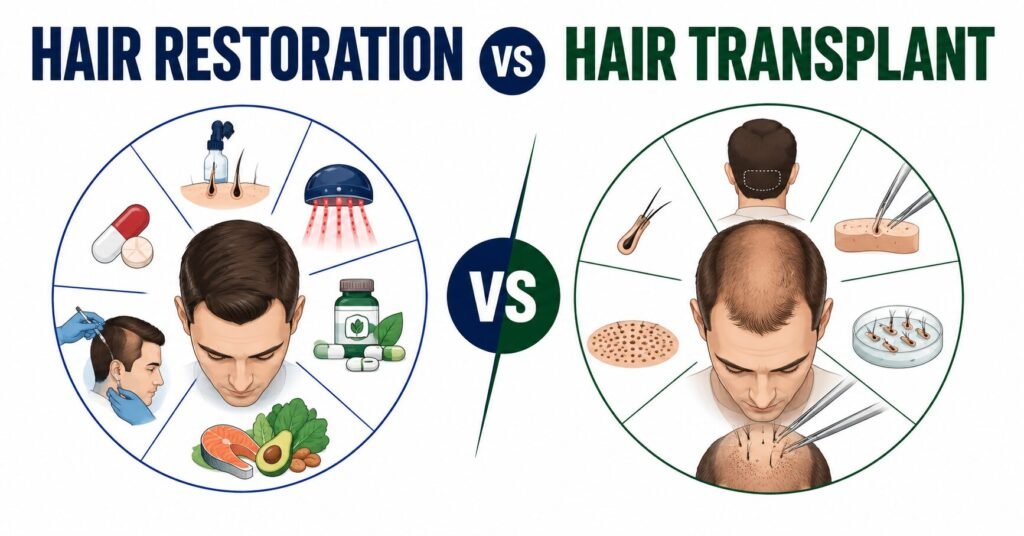
The terms Hair Restoration and hair transplant are sometimes used interchangeably, but they are not exactly the same.
Hair transplantation is one type of Hair Restoration. The broader term can include medication, PRP, laser therapy and other approaches.
A hair transplant physically moves follicles into areas affected by hair loss. Medication works differently by helping preserve or stimulate existing hair in appropriate patients.
Some people need only medical treatment. Others may benefit from surgery. Some patients use both approaches.
The best plan depends on the diagnosis and the patient's goals.
Can Hair Restoration Prevent Future Hair Loss?
Hair transplantation does not necessarily stop future hair loss.
The transplanted follicles may continue producing hair for a long time, but untreated native hair can continue to thin.
This is why a long-term Hair Restoration strategy can be important, particularly for younger patients.
Medical treatment may help preserve existing hair when appropriate. The AAD notes that hereditary hair loss treatments such as minoxidil and finasteride generally need to be continued to maintain their benefits.
Your doctor can help determine whether ongoing medical treatment should be part of your plan.
Is Hair Restoration Worth the Cost?
Whether Hair Restoration is worth the cost depends on individual expectations, financial situation and treatment goals.
A surgical transplant can be expensive, but the transplanted follicles can provide long-term growth when the patient is appropriately selected and the procedure is performed well.
Non-surgical options may cost less initially, but some require ongoing treatment and maintenance.
For example, minoxidil needs to be used continuously to maintain benefits, while PRP typically involves repeated sessions.
Instead of comparing only the initial price, consider the total long-term cost and expected benefits.
Must Read:
- Top 5 Best Hair Growth Products for Men and Women
- 10 Best Natural Treatments for Hair Loss and Regrowth
- Redken Extreme Length Shampoo Review: Benefits,
Final Thoughts:
Hair Restoration has changed considerably over the years. Today's treatment options range from topical medications and prescription treatments to PRP, laser therapy and modern hair transplantation.
The most important step is identifying the cause of hair loss before choosing a treatment. The American Academy of Dermatology recommends diagnosing the cause because treatment varies according to the type of hair loss.
For people considering a transplant, FUE and FUT remain important surgical techniques. FUE removes individual follicular units, while FUT uses strip harvesting. Neither approach is automatically best for everyone. The right technique depends on donor hair, hair-loss pattern, treatment goals and surgical assessment.
The cost of Hair Restoration in the USA can vary widely. A 2026 national cost guide places hair transplant costs at approximately $3,919 to $10,640, while some complex procedures can cost substantially more.
When choosing a clinic, focus on medical qualifications, physician involvement, experience, realistic expectations, transparent pricing and long-term follow-up. Do not select a clinic simply because it offers the lowest price or promises guaranteed results.
The best Hair Restoration plan is one that matches the cause of your hair loss, protects your existing hair and provides realistic expectations about cost, recovery and results. A consultation with a qualified dermatologist or experienced hair restoration physician can help you understand which option is appropriate for your individual situation.
Medical Disclaimer: This article is for general educational purposes and does not replace medical diagnosis or personalised treatment. Hair loss can have many causes, and treatments have different risks, benefits and contraindications. Speak with a qualified dermatologist or hair restoration physician before starting medication, undergoing PRP or considering hair transplant surgery.