
Rhinoplasty Cost is one of the first things people consider when they are thinking about nose surgery in the United States. Rhinoplasty, commonly called a nose job, can change the shape, size or proportions of the nose and may also be performed to improve breathing.
Because the procedure is highly customised, there is no single price that applies to every patient. The final Rhinoplasty Cost depends on the surgeon, location, complexity of the procedure, anaesthesia, surgical facility and whether the surgery is cosmetic or medically necessary.
For patients planning treatment in 2026, understanding the difference between a surgeon's fee and the total cost is especially important. The American Society of Plastic Surgeons currently reports an average rhinoplasty surgeon fee of $7,637, but this figure does not include anaesthesia, operating room or other related expenses. Its 2024 projected surgeon-fee range for rhinoplasty was $7,500 to $12,500.
This guide explains Rhinoplasty Cost in the USA, what the price may include, the factors that influence the final bill, insurance coverage, different types of rhinoplasty, the procedure itself, recovery, risks and questions to ask before choosing a surgeon.
How Much Does Rhinoplasty Cost in the USA?
Rhinoplasty Cost in the USA varies widely because every procedure is planned around the patient's anatomy and goals. According to the American Society of Plastic Surgeons, the latest average surgeon fee listed for rhinoplasty is $7,637. However, this is a surgeon fee rather than the complete price of surgery. Anaesthesia, facility charges, medical tests, prescriptions and other expenses can be added to the final bill.
The ASPS 2024 data provide another useful reference point. The organisation reported a projected surgeon or physician fee range of $7,500 to $12,500 for nose reshaping, based on averages submitted by surveyed ASPS member surgeons. ASPS explains that the range reflects differences in geographic location and practice settings.
For this reason, it is better to think about Rhinoplasty Cost as a total treatment budget rather than one advertised number. A clinic may promote a surgeon fee that looks affordable, but the final amount can be higher after anaesthesia, facility and other medical expenses are added.
Average Rhinoplasty Cost at a Glance
| Cost component | Typical consideration |
|---|---|
| Surgeon fee | Major part of the procedure cost |
| Anaesthesia | Usually billed separately |
| Surgical facility | May be a hospital or accredited surgical centre |
| Medical testing | May be required before surgery |
| Prescription medication | Usually an additional expense |
| Follow-up appointments | May or may not be included |
| Revision surgery | Additional cost if required |
| Insurance | Depends on medical necessity and policy |
These figures should be treated as planning information rather than a personalised quotation. The actual Rhinoplasty Cost can only be confirmed after a consultation and a review of your insurance or payment arrangements.
What Is Included in Rhinoplasty Cost?
Rhinoplasty Cost can contain several separate charges. Some surgeons provide package pricing, while others bill each component individually.
The surgeon's fee covers the professional work involved in planning and performing the operation. This fee can vary based on the surgeon's training, experience, geographic location and complexity of the procedure. ASPS specifically states that surgeon experience, procedure type and geographic location affect the surgeon fee.
Anaesthesia is another important part of Rhinoplasty Cost. Depending on the procedure and the surgeon's plan, patients may receive general anaesthesia or local anaesthesia with sedation. Anaesthesia charges may be separate from the surgeon's fee.
The surgical facility also contributes to the total Rhinoplasty Cost. Surgery may take place in an accredited outpatient surgical centre, hospital or another appropriate surgical setting. Facility fees can include use of the operating room, medical equipment and recovery area.
Other potential expenses include medical tests, prescription medication and post-surgery supplies. ASPS lists anaesthesia, hospital or surgical facility costs, medical tests, post-surgery garments, prescription medication and the surgeon's fee among possible rhinoplasty expenses.
Factors That Affect Rhinoplasty Cost

Several factors can change Rhinoplasty Cost from one patient to another. Two people having surgery in the same city may receive very different estimates because their procedures may require different surgical techniques.
Surgeon Experience
A surgeon's experience can have a major effect on Rhinoplasty Cost. Surgeons who perform rhinoplasty frequently may charge more because of their training, experience and demand.
Price should not be the only factor when selecting a surgeon. ASPS recommends considering surgeon experience and patient comfort rather than choosing a surgeon based only on the lowest fee.
Geographic Location
Where you have surgery can influence Rhinoplasty Cost. Prices may be higher in major metropolitan areas where medical facility costs, staffing expenses and demand are higher.
A quote from New York, Los Angeles, Miami or another major city may differ considerably from a quote from a smaller city or region.
Procedure Complexity
A straightforward cosmetic rhinoplasty may cost less than a complex operation involving significant structural changes.
Patients requiring major reshaping, cartilage grafts or correction of previous surgery may have higher Rhinoplasty Cost because the operation can require more surgical planning and time.
Primary vs Revision Rhinoplasty
Primary rhinoplasty is performed on a nose that has not previously undergone rhinoplasty.
Revision rhinoplasty, sometimes called secondary rhinoplasty, corrects or modifies a nose after previous surgery. Revision procedures can be more complicated because scar tissue and altered nasal structures may make surgery more technically demanding. Cleveland Clinic identifies secondary rhinoplasty as a procedure used to revise or correct problems after an earlier rhinoplasty.
Because revision surgery may require additional techniques or cartilage grafts, the Rhinoplasty Cost can be higher.
Open vs Closed Rhinoplasty
The surgical technique can also affect Rhinoplasty Cost.
In closed rhinoplasty, incisions are made inside the nose. In open rhinoplasty, the surgeon also makes a small incision across the columella, the tissue separating the nostrils. The choice depends on the patient's anatomy and the changes required.
Neither approach is automatically better for everyone. The surgeon selects the technique that best suits the patient's goals and anatomy.
Cosmetic Rhinoplasty vs Functional Rhinoplasty
Understanding the purpose of surgery is important when calculating Rhinoplasty Cost.
Cosmetic rhinoplasty is performed primarily to change the appearance of the nose. Patients may want to reduce a bump, refine the nasal tip, change the width of the nose or improve facial balance.
Functional rhinoplasty is performed to address structural problems that affect nasal breathing or function. Rhinoplasty may also be combined with procedures such as septoplasty when a deviated septum contributes to breathing problems.
The difference matters financially because insurance generally does not cover surgery performed only for cosmetic reasons. However, medically necessary nasal surgery to improve breathing may be eligible for coverage depending on the patient's insurance policy and documentation.
Does Insurance Cover Rhinoplasty?
Insurance coverage is one of the most important considerations when calculating Rhinoplasty Cost.
Cosmetic rhinoplasty is generally considered elective and is typically not covered by health insurance. However, some or all of a medically necessary nasal procedure may be covered when the purpose is to correct a breathing problem, structural abnormality, injury or another documented medical condition.
For example, a patient with significant nasal obstruction caused by structural problems may receive insurance coverage for the functional portion of treatment. A cosmetic change performed at the same time may still be the patient's responsibility.
ASPS notes that functional nose surgery may be considered reconstructive and may be covered when an obstructed airway is documented, but prior authorisation from the insurer may be required.
Before scheduling surgery, ask your insurer:
- Is functional rhinoplasty covered?
- Is septoplasty covered?
- Does my plan require prior authorisation?
- Is the surgeon in network?
- Is the surgical facility in network?
- Is anaesthesia covered?
- What deductible applies?
- What coinsurance will I pay?
- What is my out-of-pocket maximum?
- Which portion of the surgery is considered cosmetic?
Getting written confirmation is useful because an insurance estimate is not necessarily the same as the final bill.
Rhinoplasty Cost for Cosmetic Surgery
Cosmetic Rhinoplasty Cost is normally paid by the patient because changing the appearance of the nose is generally not considered medically necessary.
The total price may include the surgeon's fee, anaesthesia, facility costs and other medical expenses. The ASPS surgeon-fee data provide a useful benchmark, but patients should request a complete written estimate rather than assuming the surgeon fee is the final price.
Some plastic surgeons offer financing options for patients who prefer to spread payments over time. ASPS notes that many plastic surgeons provide patient financing plans.
If financing is being considered, review the interest rate, fees, repayment period and total amount paid rather than looking only at the monthly payment.
Rhinoplasty Cost for Functional Surgery
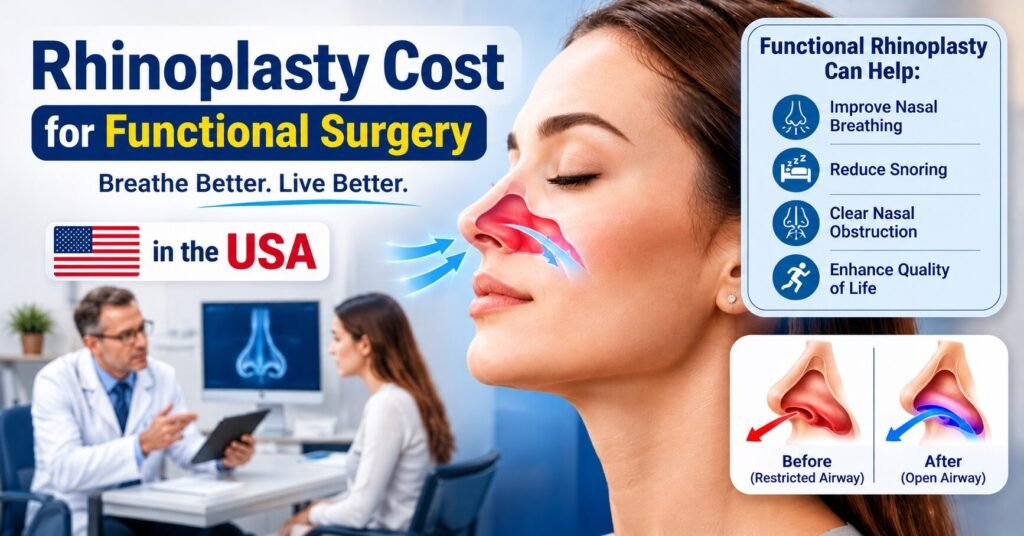
Functional rhinoplasty can have a different financial structure because insurance may cover medically necessary treatment.
A patient who has difficulty breathing because of a deviated septum or another structural problem may need an examination and documentation before insurance approves treatment. The functional component may be eligible for coverage, while cosmetic modifications may remain self-pay.
Mayo Clinic explains that rhinoplasty can be performed to change appearance, improve breathing or achieve both goals.
If you need both functional and cosmetic changes, ask your surgeon and insurer to separate the medically necessary portion from the elective cosmetic portion in the estimate.
What Happens During Rhinoplasty?
The rhinoplasty procedure is highly personalised. The surgeon develops a surgical plan based on the patient's facial proportions, nasal structure, skin characteristics and desired changes.
Mayo Clinic explains that rhinoplasty can change bone, cartilage, skin or a combination of these structures. Depending on the goals of surgery, cartilage may be reshaped or additional cartilage may be used to support or modify the nose.
Before surgery, the patient receives anaesthesia. Depending on the complexity of the operation and the surgeon's preference, this may involve general anaesthesia or local anaesthesia with sedation.
The surgeon then makes the planned incisions and reshapes the underlying nasal structures. In some cases, cartilage may be taken from inside the nose or ear. More extensive reconstruction may require cartilage from the rib or another source.
After the desired structural changes are completed, the skin and tissues are repositioned and the incisions are closed.
How Long Does Rhinoplasty Take?
The length of rhinoplasty surgery varies depending on the complexity of the operation.
A simple procedure may require less operating time than a complex revision rhinoplasty or a procedure combining cosmetic and functional corrections.
Because rhinoplasty is highly customised, patients should ask their surgeon how long their specific operation is expected to take.
Most people can leave the hospital or surgical facility on the same day, although some patients may need overnight monitoring depending on their health and circumstances. Mayo Clinic states that nearly everyone undergoing rhinoplasty can safely leave the hospital the same day, with overnight stays being uncommon.
Rhinoplasty Recovery Timeline
Recovery is another important part of planning Rhinoplasty Cost because patients may need time away from work and may have additional expenses during healing.
Mayo Clinic recommends planning to take approximately one week away from work, school or other normal duties. Many people feel substantially better after the first week, although swelling can continue for months.
During the first several days, swelling, nasal congestion and mild drainage can occur. A splint may be placed on the nose and is commonly kept in position for approximately one week.
Bruising around the eyes may occur and can last for two to three weeks. Nasal swelling can last much longer, and Mayo Clinic notes that most swelling is gone within about a year.
This means patients should not judge their final rhinoplasty result immediately after surgery.
First Week
The first week usually involves the most noticeable swelling and congestion. Patients are generally advised to rest with the head elevated and follow their surgeon's instructions carefully.
The nasal splint is often removed around the one-week follow-up appointment.
Two to Four Weeks
Many patients can gradually return to most normal activities during this period. However, intense exercise and activities that could cause trauma to the nose may still be restricted.
Cleveland Clinic notes that light activities can often resume after a few days, but full physical activity may require several weeks.
Several Months
The nose continues to settle and change as swelling decreases. Small changes may remain noticeable for months.
The final appearance may take much longer to become clear, particularly after more complex surgery.
Is Rhinoplasty Painful?
Rhinoplasty discomfort varies from person to person. Mayo Clinic reports that most people experience relatively low pain levels after surgery, although congestion, pressure and swelling can be uncomfortable.
Your surgeon may prescribe or recommend pain medication and provide instructions for managing discomfort.
Patients should take only medications approved by their surgeon because some medicines can increase bleeding risk.
Risks of Rhinoplasty
Rhinoplasty is a surgical procedure and therefore has potential risks. Understanding these risks is just as important as understanding Rhinoplasty Cost.
General surgical risks can include bleeding, infection and reactions to anaesthesia. Rhinoplasty-specific risks may include breathing problems, numbness, uneven appearance, persistent swelling, scarring, septal perforation, changes in smell and the possibility of additional surgery.
The actual risk depends on the patient's health, anatomy, surgical technique and other factors.
A consultation should include a discussion of both the expected benefits and possible complications.
How to Choose a Rhinoplasty Surgeon
Choosing a qualified surgeon is more important than finding the lowest Rhinoplasty Cost.
Look for a surgeon who is appropriately trained and board certified in a relevant specialty. Experience with rhinoplasty is particularly valuable because the procedure requires detailed understanding of both nasal appearance and function.
ASPS advises patients to research surgeons, consider experience and prioritise safety rather than choosing based only on price.
During a consultation, review before-and-after photographs of patients with similar nasal characteristics. Ask about the surgeon's experience with primary and revision rhinoplasty if applicable.
You should also confirm that surgery will be performed in an appropriately accredited surgical facility or hospital.
Questions to Ask Before Paying for Rhinoplasty
Before committing to surgery, ask your surgeon for a detailed explanation of the Rhinoplasty Cost.
Useful questions include:
- What is the total Rhinoplasty Cost?
- Is the quoted price the complete surgical cost?
- Does it include anaesthesia?
- Does it include the surgical facility?
- Are medications included?
- Are follow-up visits included?
- What happens if I need additional treatment?
- Is this cosmetic or functional rhinoplasty?
- Could insurance cover any portion?
- What are my expected recovery restrictions?
- How long will I need to take off work?
- Is revision surgery included if a problem develops?
- What credentials and board certifications do you have?
- How frequently do you perform rhinoplasty?
- Where will my surgery be performed?
A written estimate can help prevent misunderstandings about the final Rhinoplasty Cost.
How to Save Money Without Choosing an Unsafe Option
Patients naturally want to control Rhinoplasty Cost, but choosing the cheapest surgeon is not necessarily the safest way to reduce expenses.
Instead, compare complete quotes from qualified surgeons. Ask each practice to explain what is included in the price.
You can also compare accredited surgical facilities and ask whether the surgeon offers financing.
If your surgery has a functional component, check whether your insurance may cover medically necessary treatment. Proper documentation and prior authorisation may make a significant difference to your out-of-pocket Rhinoplasty Cost.
Avoid choosing a provider solely because an online advertisement promises an unusually low price. A very low quote may not include anaesthesia, facility fees or other important expenses.
Rhinoplasty vs Septoplasty

Rhinoplasty and septoplasty are different procedures, although they can sometimes be performed together.
Rhinoplasty primarily changes the external shape or structural form of the nose and may also improve breathing. Septoplasty focuses on correcting the nasal septum, the internal structure separating the two sides of the nose.
If a patient has both cosmetic concerns and a deviated septum, the surgeon may recommend combining procedures.
This can affect Rhinoplasty Cost because multiple surgical services, anaesthesia and facility charges may be involved.
When Is Rhinoplasty Worth the Cost?
Whether Rhinoplasty Cost is worthwhile depends on the individual's goals, expectations and circumstances.
For someone who has been unhappy with the appearance of their nose for years, cosmetic rhinoplasty may provide a meaningful change in facial balance and confidence.
For someone with significant structural breathing problems, functional rhinoplasty may offer both aesthetic and functional benefits.
However, rhinoplasty cannot guarantee perfection. Mayo Clinic emphasises that the procedure is complex and that expectations should be discussed carefully with the surgeon.
A realistic goal is improvement rather than expecting a completely symmetrical or flawless nose.
Must Read:
- Beauty Supplements For Glowing Skin At Best Offers
- Best Supplements For Skin Health: Long-Lasting Glow
- Is Red Light Therapy Right for Your Skin?
FAQs:
How much does rhinoplasty cost in the USA?
Rhinoplasty Cost varies by surgeon, location and procedure complexity. ASPS currently lists an average surgeon fee of $7,637, while its 2024 projected surgeon-fee range was $7,500 to $12,500. These figures do not represent the complete price because anaesthesia and facility expenses may be additional.
What is the average Rhinoplasty Cost in 2026?
There is no single official national 2026 total price. For current planning, ASPS's latest published figures are a useful benchmark, but the organisation's listed $7,637 figure is a surgeon fee rather than an all-inclusive 2026 treatment price. Patients should request a current written quote from their surgeon.
Does insurance cover rhinoplasty?
Cosmetic rhinoplasty is generally not covered. Functional surgery performed to correct breathing problems may qualify for coverage depending on the insurance plan and medical documentation. Prior authorisation may be required.
How long does rhinoplasty recovery take?
Many people can return to work or school after about one week, but swelling can continue for several months. Mayo Clinic notes that most swelling is gone within approximately one year.
Is rhinoplasty painful?
Most patients experience manageable discomfort rather than severe pain. Swelling, congestion and pressure can be more noticeable during the early recovery period. Your surgeon will provide appropriate pain-management instructions.
Does revision rhinoplasty cost more?
Revision rhinoplasty can cost more than primary rhinoplasty because the surgeon may need to work with scar tissue and altered cartilage or bone. The complexity of the revision determines the actual price.
Final Thoughts:
Rhinoplasty Cost in the USA depends on much more than the surgeon's advertised price. The latest ASPS information lists an average surgeon fee of $7,637, while its 2024 projected surgeon-fee range for rhinoplasty was $7,500 to $12,500. These numbers are useful benchmarks, but they do not include every expense associated with surgery.
Anaesthesia, surgical facility fees, medical tests, prescriptions and other expenses can increase the final Rhinoplasty Cost. The price can also change based on the surgeon's experience, location, surgical technique, complexity and whether the procedure is primary, revision, cosmetic or functional.
Insurance usually does not cover cosmetic rhinoplasty, but medically necessary nasal surgery that improves breathing may qualify for coverage under certain insurance plans. Patients should confirm coverage and obtain prior authorisation before surgery when required.
Recovery is another important consideration. Most patients can return to many normal activities relatively quickly, but swelling can continue for months and final results may take up to a year to become fully apparent.
The most important decision should not be based solely on Rhinoplasty Cost. Choose a properly trained and appropriately board-certified surgeon with substantial rhinoplasty experience, ask for a complete written estimate and make sure you understand the expected results, recovery process and possible risks.
Medical Disclaimer: This article is intended for general educational purposes and does not replace professional medical advice, diagnosis or treatment. Rhinoplasty is a surgical procedure with individual risks and costs. Prices and insurance coverage can change, so confirm current fees and coverage directly with your surgeon, surgical facility and insurance provider.