Dental Implant Cost is one of the first things people consider when they need to replace a missing or severely damaged tooth. Dental implants can provide a long-term way to replace a tooth, but the total price in the USA can vary significantly depending on the number of implants, location, dentist or oral surgeon, materials, preparatory procedures and insurance coverage.
In 2026, a single dental implant commonly costs around $3,000 to $6,000 when the implant post, abutment and crown are included. Some patients may pay less, while complex cases can cost considerably more. Delta Dental, for example, reports a range of approximately $2,800 to $5,600 for an individual implant without dental benefits, while other 2026 pricing sources place the typical all-in range at $3,000 to $6,000.
Understanding Dental Implant Cost before treatment can help you compare dental practices, understand insurance benefits and avoid unexpected charges. This guide explains dental implant prices in the USA, what is included in the cost, insurance coverage, financing options, additional procedures and ways to make treatment more affordable.
What Are Dental Implants?
Dental implants are artificial tooth roots that are placed into the jawbone to support a replacement tooth. Most traditional dental implants use a titanium post that functions as the replacement root. An abutment connects the implant to the visible crown.
Unlike a traditional removable denture, a dental implant is anchored in the jaw. Once the implant has integrated with the bone, it can provide a stable foundation for a crown, bridge or denture.
The American Dental Association explains that dental implants can be used to replace missing teeth and support different types of dental restorations. The treatment normally involves several stages and appointments.
Because multiple components are involved, Dental Implant Cost is not simply the price of the titanium implant itself. Patients need to consider the implant, abutment, crown, diagnostic imaging, surgery and any additional treatment required before the implant can be placed.
How Much Does a Dental Implant Cost in the USA?
The average Dental Implant Cost in the USA depends on the type of restoration and the patient's individual treatment plan.
For a single tooth, a reasonable 2026 planning range is approximately $3,000 to $6,000 for an implant, abutment and crown. Some clinics may quote a price outside this range because of differences in location, materials, surgical complexity and additional procedures.
Aspen Dental reports an average 2026 price of approximately $4,259 per implant, with a reported range of $3,158 to $6,533. Its figure includes surgical placement and the three major components of the restoration, although individual pricing varies.
Another important point is that dental offices do not always advertise an all-inclusive price. A quote that looks inexpensive may cover only the implant placement and exclude the crown, abutment, imaging or bone graft.
For this reason, always ask for a complete written treatment estimate before scheduling treatment.
Dental Implant Cost Breakdown
Understanding the individual parts of treatment makes it easier to compare prices.
Implant Post
The implant post is the component placed into the jawbone. It acts as an artificial tooth root.
The implant is normally made from titanium or another biocompatible material. The cost depends on the implant system, material and dentist or oral surgeon performing the procedure.
Abutment
The abutment connects the implant post to the crown.
Some dental practices include the abutment in their advertised implant price, while others charge it separately. This is one reason two apparently similar dental implant quotes can have different final prices.
Dental Crown
The crown is the visible replacement tooth attached to the implant.
The crown is designed to match the surrounding teeth in shape and colour. The material used can influence the price.
A complete single-tooth implant therefore involves more than inserting a post into the jaw. The final restoration is an important part of the total Dental Implant Cost.
Average Dental Implant Cost by Treatment Type
The price increases when multiple teeth need replacement.
| Dental Implant Treatment | Typical 2026 Price Range |
|---|---|
| Single dental implant | $3,000-$6,000 |
| Implant-supported bridge | $6,000-$15,000 |
| All-on-4, per arch | $15,000-$30,000+ |
| All-on-6, per arch | $20,000-$35,000+ |
| Full-mouth restoration | $25,000-$95,000+ |
These figures are general planning ranges rather than fixed national prices. Current 2026 pricing sources show substantial variation between providers and treatment types.
A patient replacing one tooth will have a very different Dental Implant Cost from someone replacing an entire upper or lower arch.
What Factors Affect Dental Implant Cost?
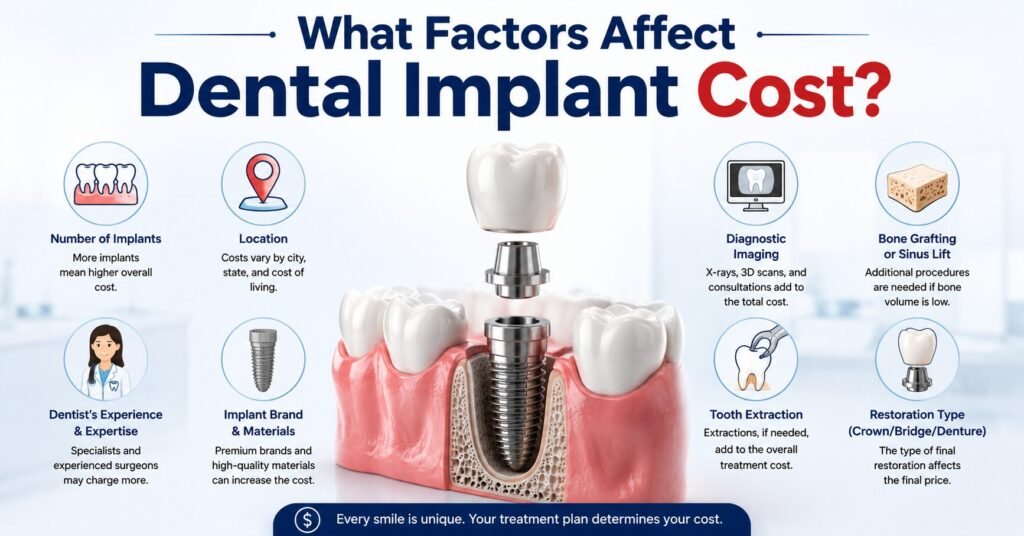
Several factors can change the final price of dental implants.
Number of Implants
The number of implants is one of the most obvious cost factors.
Replacing one missing tooth generally requires one implant and one crown. Multiple missing teeth may require several implants or an implant-supported bridge.
Full-arch treatment uses a different treatment approach and can cost tens of thousands of dollars.
Location
The cost of dental care differs between cities and states.
Dental practices in major metropolitan areas may have higher facility, staffing and operating expenses. These costs can influence the final Dental Implant Cost.
The same treatment can therefore have different prices in different parts of the USA.
Dentist or Oral Surgeon
The professional performing your treatment also affects the cost.
Dental implants may involve a general dentist, prosthodontist, periodontist or oral and maxillofacial surgeon, depending on the case.
More complicated cases may require several specialists. A higher professional fee is not necessarily a sign that treatment is better, but qualifications, experience and surgical expertise should be considered alongside price.
Implant Materials
The type and brand of implant system can influence the price.
The crown material can also affect the final bill. Ask your dentist what materials are being recommended and whether the quoted price includes all components.
Diagnostic Imaging
Dental implants often require detailed evaluation of the jawbone and surrounding structures.
Your dentist may recommend X-rays or three-dimensional imaging such as a CBCT scan. Imaging costs may be included in the consultation or billed separately.
Bone Grafting
Some patients do not have enough bone volume to support an implant immediately.
Bone loss can occur after a tooth has been missing for some time. If additional bone is required, a bone graft may be recommended.
This adds to the overall Dental Implant Cost and can also increase the treatment timeline.
Tooth Extraction
If a damaged tooth must be removed before implant placement, extraction may be an additional expense.
Some patients can have an implant placed immediately after extraction, while others need to allow the area to heal first.
The treatment plan depends on the condition of the tooth, gum tissue and jawbone.
Additional Procedures That Can Increase Dental Implant Cost
The advertised implant price may not include every procedure a patient needs.
Additional expenses can include:
- Tooth extraction
- Bone grafting
- Sinus lift
- CBCT imaging
- Temporary teeth
- Sedation
- Anaesthesia
- Abutment
- Crown
- Additional consultations
- Follow-up appointments
A current 2026 cost guide estimates that bone grafting and sinus-lift procedures can add hundreds or several thousand dollars depending on the complexity of treatment.
This is why patients should ask for an itemised estimate rather than comparing only the advertised implant price.
Does Dental Insurance Cover Dental Implants?
Dental insurance coverage for implants varies by plan.
Some dental insurance policies cover part of the cost, while others exclude implants or provide limited benefits. Even when implants are covered, annual maximums, deductibles, waiting periods and coinsurance can significantly affect the amount a patient receives.
Delta Dental states that some of its plans cover part of dental implant treatment, but benefits depend on the individual plan. It recommends getting a pre-treatment estimate to determine what the dental plan is expected to pay.
For example, some 2026 dental plans offer implant coverage at 50% up to a specific benefit maximum. Kaiser Permanente's 2026 implant benefit options include examples with 50% coverage subject to $2,000, $3,000 or $4,000 implant benefit maximums, depending on the plan.
This means that having insurance does not necessarily mean the majority of your Dental Implant Cost will be covered.
Why Insurance May Not Pay the Full Cost
Dental insurance often has annual or lifetime benefit limits.
Suppose an implant treatment costs $4,500 and your plan covers 50% of eligible expenses but has a $2,000 annual maximum. Your actual insurance payment could be much lower than $2,250 depending on the plan's rules, deductible and covered services.
Insurance may also treat different parts of the procedure differently.
For example, the plan might have separate coverage rules for:
- Implant placement
- Crown
- Bone graft
- Extraction
- Imaging
- Anaesthesia
Always ask your insurer for a written explanation of benefits before beginning treatment.
Does Medicare Cover Dental Implants?

Original Medicare generally does not cover routine dental services or dental implants.
Medicare.gov states that in most cases, Medicare does not cover dental services such as routine dental care, extractions or dental implants. There are limited circumstances where dental services related to certain covered medical treatments may qualify for Medicare coverage.
Some Medicare Advantage plans may offer dental benefits, but coverage varies by plan.
If you have Medicare, check the specific benefits of your Medicare Advantage or separate dental plan rather than assuming implants are covered.
Does Medicaid Cover Dental Implants?
Medicaid dental benefits vary by state, and adult dental coverage can be limited.
Dental implants are not automatically covered simply because a person has Medicaid.
If you have Medicaid and are considering implants, contact your state's Medicaid programme and ask whether implant treatment is covered under your specific benefit category.
Can an HSA Pay for Dental Implants?
A Health Savings Account may provide another way to manage Dental Implant Cost.
Delta Dental notes that HSAs can be used for qualified medical expenses, including eligible dental expenses, subject to applicable rules.
Because HSA rules can depend on the specific expense and tax requirements, patients should confirm eligibility with their HSA administrator or tax professional before using funds.
Using pre-tax funds for an eligible dental expense can reduce the effective financial burden of treatment.
Can an FSA Pay for Dental Implants?
A Flexible Spending Account may also be used for eligible dental expenses.
FSAs are different from HSAs because the account rules, contribution limits and rollover provisions can vary.
If you are considering implants, check your employer's FSA rules before treatment. You should also keep receipts, treatment plans and other documentation in case verification is required.
Dental Implant Financing Options
If you cannot pay the full Dental Implant Cost upfront, several financing options may be available.
Monthly Payment Plans
Some dental practices offer payment plans that allow patients to spread the cost across multiple months.
Ask about:
- Interest rate
- Monthly payment
- Application requirements
- Origination fees
- Late fees
- Total repayment amount
A low monthly payment can look attractive, but the total amount paid over the financing period is more important.
Third-Party Healthcare Financing
Some patients use third-party healthcare financing companies for dental procedures.
These programmes may offer promotional financing or monthly payment options for qualified applicants.
Read the financing agreement carefully. Promotional offers can have specific requirements, and interest may apply if the balance is not paid according to the agreement.
Dental School Clinics
Dental schools can sometimes offer lower-cost treatment because procedures are performed in an educational environment under professional supervision.
Availability, eligibility and waiting times vary.
If you are considering this option, ask exactly who will perform the implant procedure and what level of supervision is provided.
Dental Discount Plans vs Dental Insurance
Dental discount plans are different from traditional dental insurance.
A discount plan usually requires an annual or monthly membership fee and provides discounted rates at participating dentists.
For expensive procedures, a discount plan may sometimes reduce the cash price without the annual maximums associated with some insurance policies. However, the discount depends on the participating dentist and plan.
Dental insurance, on the other hand, generally involves premiums, deductibles, coinsurance, covered services and annual limits.
Before purchasing either option specifically for implants, calculate the expected savings against the plan's fees and restrictions.
How to Reduce Dental Implant Cost Safely
Patients can take several steps to make treatment more affordable without choosing a provider based only on the cheapest price.
Compare Multiple Dentists
Get treatment plans from at least two or three qualified dental professionals when possible.
Ask each provider for an itemised quote.
Compare the total price rather than just the implant placement fee.
Ask for an All-Inclusive Price
A good question is:
“What will I pay from start to finish for this implant?”
Ask whether the quote includes the implant, abutment, crown, imaging, extraction, bone grafting and follow-up appointments.
Check Insurance Before Treatment
Contact your insurance company before scheduling surgery.
Ask:
- Is implant placement covered?
- Is the crown covered?
- Is bone grafting covered?
- What is my deductible?
- What percentage does the plan pay?
- What is my annual maximum?
- Is there a waiting period?
- Does my dentist participate in the network?
Request a pre-treatment estimate whenever possible.
Ask About Alternatives
Dental implants are not the only way to replace a missing tooth.
Depending on your oral health and goals, your dentist may discuss alternatives such as a fixed dental bridge or removable partial denture.
A lower-cost alternative may be appropriate for some patients, while an implant may provide advantages in other situations.
The decision should be based on your oral health, bone condition, budget and long-term goals.
Dental Implants vs Dental Bridges
When comparing Dental Implant Cost, patients often consider bridges as an alternative.
A dental bridge replaces a missing tooth by attaching an artificial tooth to neighbouring teeth.
An implant replaces the tooth root with an implant post and supports a crown.
The initial price of a bridge may be lower than an implant, but the long-term considerations are different.
A dentist can explain which option is appropriate based on the location of the missing tooth, condition of neighbouring teeth, bone health and your personal preferences.
Are Dental Implants Worth the Cost?
Whether dental implants are worth the Dental Implant Cost depends on your individual situation.
Implants can provide a stable foundation for replacement teeth and are designed to function similarly to natural teeth. They can also be maintained with regular oral hygiene and professional dental care.
However, implants require surgery, healing time and a substantial financial investment.
The best choice is not necessarily the cheapest treatment. It is the treatment that provides an appropriate balance of oral health, function, durability, aesthetics and affordability.
Discuss the expected benefits and potential risks with your dentist before making a decision.
How Long Does Dental Implant Treatment Take?
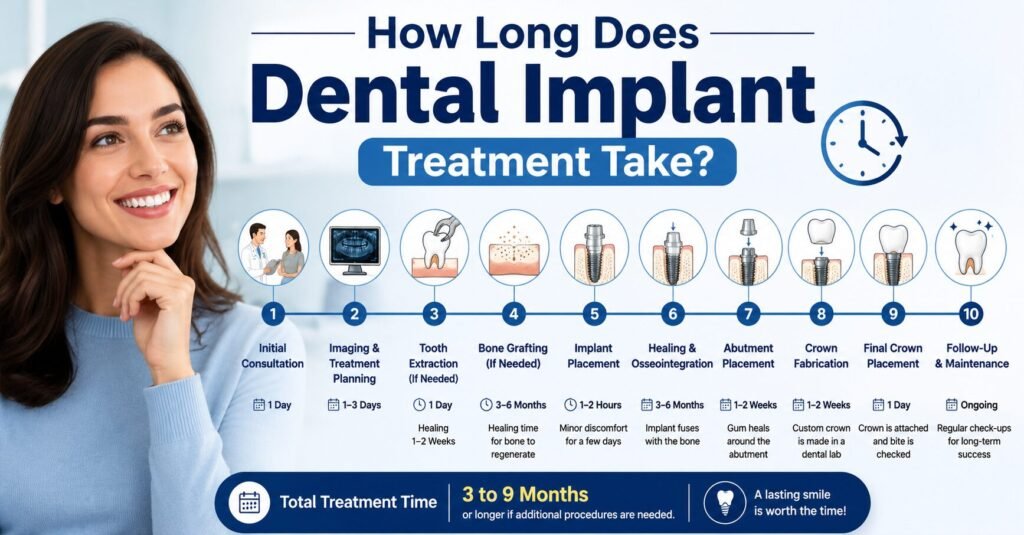
Dental implant treatment can take several months because the implant needs time to integrate with the jawbone before the final restoration is attached.
Some patients may receive immediate or early restoration depending on their bone quality and clinical situation.
Others may need bone grafting before implant placement, which can extend the treatment timeline.
Your dentist should provide a personalised schedule explaining:
- Initial consultation
- Imaging
- Extraction, if needed
- Bone grafting, if needed
- Implant placement
- Healing and integration
- Abutment placement
- Crown fabrication
- Final crown placement
- Follow-up care
The treatment timeline is another important consideration when evaluating Dental Implant Cost.
Questions to Ask Before Paying for Dental Implants
Before committing to treatment, ask your dentist:
- What is the complete Dental Implant Cost?
- Is the crown included?
- Is the abutment included?
- Does the price include imaging?
- Do I need a bone graft?
- Do I need a tooth extraction?
- Who will place the implant?
- What implant brand and material will be used?
- What type of crown will I receive?
- Does insurance cover any portion?
- Can you submit a pre-treatment estimate?
- Are financing options available?
- What happens if complications occur?
- How many appointments will I need?
- How long will treatment take?
- What alternatives are available?
These questions can help you understand the real cost before treatment begins.
Must Read:
- Top 5 Natural Remedies for Toothache Relief
- Top Vitamins for Teeth: Boost Your Dental Health Naturally
- Best Way to Brush Your Teeth for a Brighter Smile and Fresher Breath
FAQs:
How much does one dental implant cost in the USA?
A single dental implant commonly costs approximately $3,000 to $6,000 when the implant, abutment and crown are included. Actual prices vary by location, dentist, materials and additional procedures.
Does dental insurance pay for implants?
Some dental insurance plans cover part of implant treatment, but coverage varies. Deductibles, coinsurance, waiting periods and annual maximums can significantly affect your out-of-pocket Dental Implant Cost.
Does Medicare cover dental implants?
Original Medicare generally does not cover dental implants. There are limited exceptions involving certain medically necessary dental services associated with covered medical treatment.
Can I finance dental implants?
Yes. Many dental practices and third-party healthcare financing providers offer monthly payment options for qualified patients. Always compare the interest rate and total repayment amount before choosing financing.
Why are dental implants so expensive?
Dental Implant Cost includes more than the implant post. The total can include consultations, imaging, surgery, implant components, abutment, crown, anaesthesia, extraction and bone grafting.
What is the cheapest way to get dental implants?
Comparing qualified providers, checking insurance benefits, using eligible HSA or FSA funds, considering dental school clinics and comparing financing options may help reduce your out-of-pocket cost. Do not choose a provider based solely on the lowest advertised price.
FAQs:
Dental Implant Cost in the USA can vary considerably, but a reasonable 2026 planning range for a single complete implant is approximately $3,000 to $6,000. Some providers charge less or more depending on the location, materials, professional fees and complexity of the case.
Insurance can reduce your out-of-pocket expense, but coverage is highly dependent on the specific dental plan. Some policies provide partial implant coverage, while others exclude implants or impose benefit limits.
Financing, HSA and FSA funds, dental discount programmes and treatment at dental schools may provide additional ways to manage expenses, depending on eligibility.
The most important step is to get a detailed treatment plan before beginning. Ask your dentist for the complete price, including the implant, abutment, crown, imaging, extraction, bone grafting and other required services.
Rather than choosing a dental practice simply because it advertises the lowest Dental Implant Cost, consider the dentist's qualifications, experience, treatment approach, facility standards and follow-up care. A slightly higher initial price may be worthwhile if it provides appropriate professional care and a comprehensive treatment plan.
Medical Disclaimer: This article is for general educational purposes and does not replace professional dental advice. Dental implant treatment has individual risks, benefits and costs. Speak with a qualified dentist, prosthodontist, periodontist or oral and maxillofacial surgeon to determine whether dental implants are appropriate for you and to receive a personalised cost estimate.