Choosing the right Breast Augmentation Surgeon is one of the most important decisions you can make before breast augmentation surgery. Breast augmentation is an elective surgical procedure that can change the size, shape and overall appearance of the breasts, so the surgeon you choose can have a major influence on your safety, surgical experience and final result.
A good Breast Augmentation Surgeon should have appropriate plastic surgery training, recognised board certification, extensive experience with breast procedures and a surgical facility that meets accepted safety standards. The American Society of Plastic Surgeons recommends choosing a board-certified plastic surgeon, specifically noting certification by the American Board of Plastic Surgery (ABPS) for its U.S. members.
When comparing a Breast Augmentation Surgeon in the USA, it is important to look beyond attractive before-and-after photographs or a low advertised price. You should evaluate credentials, experience, implant knowledge, communication, surgical facility standards, follow-up care and the surgeon's approach to your individual goals.
The U.S. Food and Drug Administration also recommends discussing the surgeon's experience, board certification, patient follow-up and your comfort level with the surgeon before choosing breast implants.
This guide explains how to research a Breast Augmentation Surgeon, what credentials to check, which questions to ask during a consultation, how to evaluate before-and-after photographs, what to know about implants and safety, and how to compare surgeons before making your final decision.
Why Choosing the Right Breast Augmentation Surgeon Matters?
A qualified Breast Augmentation Surgeon does more than place breast implants. The surgeon evaluates your anatomy, discusses your goals, considers your existing breast tissue and recommends an appropriate surgical plan. Breast augmentation can involve different implant sizes, shapes, surfaces, placement options and incision locations, so the procedure needs to be customised to each patient. The FDA recommends discussing these choices with your surgeon and understanding why a particular implant and surgical approach is being recommended.
The right Breast Augmentation Surgeon should also explain realistic expectations rather than promising a perfect result. Breast size, chest width, skin quality, existing breast tissue, asymmetry and body proportions can all affect the final appearance. A responsible surgeon should explain what surgery can realistically achieve and discuss potential limitations before you make a decision.
Safety should remain the first priority. Breast augmentation is surgery, and implants are medical devices that can have complications and may require additional procedures in the future. The FDA states that breast implants are not lifetime devices and that patients may require additional surgery because of complications or other changes over time.
Check the Breast Augmentation Surgeon's Board Certification
One of the first things to check when choosing a Breast Augmentation Surgeon is board certification. In the USA, patients should verify whether the surgeon is certified by the American Board of Plastic Surgery, rather than relying on vague terms such as “board certified” without knowing which board issued the certification.
The American Society of Plastic Surgeons explains that its member surgeons meet standards that include ABPS certification, extensive surgical training, examinations, continuing medical education and performing surgery in appropriately accredited, state-licensed or Medicare-certified facilities.
Why ABPS Certification Matters
An ABPS-certified Breast Augmentation Surgeon has completed specialised plastic surgery training and met the certification requirements established by the recognised specialty board. ASPS also warns patients not to become confused by other official-sounding boards or certifications and notes that there is no ABMS-recognised certifying board with “cosmetic surgery” in its name.
Board certification does not guarantee a particular cosmetic result, but it is an important credential to verify when creating your shortlist of surgeons.
How to Verify Credentials
Before booking surgery with a Breast Augmentation Surgeon, verify:
- Medical licence
- ABPS board certification
- Plastic surgery training
- Hospital privileges
- Professional society membership
- Surgical facility accreditation
- Experience with breast augmentation
- Experience with the implant type you are considering
Do not rely only on a surgeon's website. Independent professional and state licensing resources can help confirm credentials.
Look for Specific Breast Augmentation Experience
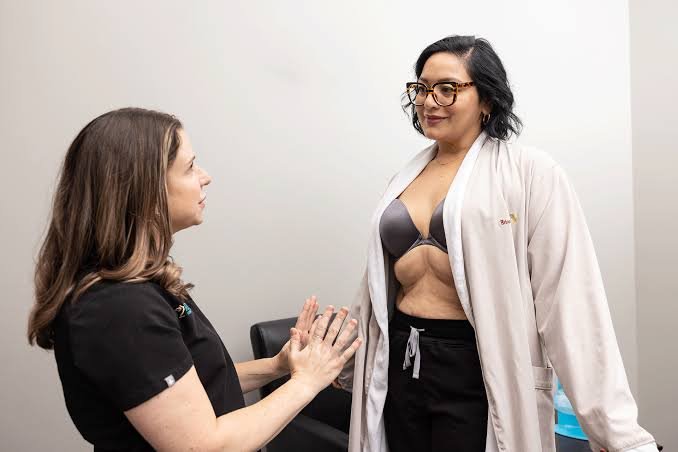
A Breast Augmentation Surgeon may perform many different cosmetic procedures, but you should ask how frequently the surgeon performs breast augmentation specifically. Experience with breast procedures can be especially valuable because breast augmentation requires detailed planning around implant size, breast shape, tissue thickness, chest anatomy and symmetry.
The FDA specifically recommends asking surgeons how many breast implant procedures they perform each year and what percentage of their practice is dedicated to breast augmentation or breast reconstruction.
Questions About Surgical Experience
During your consultation, ask your Breast Augmentation Surgeon:
- How many breast augmentations do you perform each year?
- How many years have you performed breast augmentation?
- What percentage of your practice involves breast surgery?
- How often do you perform revision breast surgery?
- What complications do you see most frequently?
- What is your reoperation rate?
- Which implant brands and types do you commonly use?
- How do you decide which implant is appropriate for a patient?
These questions can give you a better understanding of whether breast augmentation is a significant part of the surgeon's practice.
Review Before-and-After Photos Carefully
Before-and-after photographs can help you understand a Breast Augmentation Surgeon's aesthetic style. However, photographs should not be the only reason you choose a surgeon.
Look for patients with anatomy, body proportions and starting breast size that are reasonably similar to yours. Pay attention to whether the surgeon's results generally look natural, proportionate and consistent.
What to Look for in Photos
When reviewing a Breast Augmentation Surgeon portfolio, consider:
- Breast shape
- Breast symmetry
- Implant position
- Upper-pole fullness
- Cleavage appearance
- Nipple position
- Overall body proportion
- Incision appearance
- Consistency between different patients
Ask whether the photographs are actual patients of the surgeon and whether they represent results from the same type of procedure you are considering.
A surgeon who shows many different outcomes may give you a more realistic understanding of what breast augmentation can achieve.
Consider the Surgeon's Approach to Natural-Looking Results
The best Breast Augmentation Surgeon for you may not be the surgeon who recommends the largest implants. A good surgeon should consider your anatomy and personal preferences rather than simply selecting a large implant because it is popular.
Your desired result could be subtle, athletic, natural-looking, fuller or more dramatic. The surgeon should listen carefully to your preferences and explain what is realistic for your body.
Breast implant size is only one part of the final result. Implant profile, shape, placement and the amount of natural breast tissue can also affect the appearance.
The FDA recommends discussing implant shape, size, surface texture, placement and incision location with your surgeon before surgery.
Understand Breast Implant Options
Your Breast Augmentation Surgeon should explain the available implant options rather than simply recommending one product without discussion.
The FDA currently identifies two broad types of breast implants approved for sale in the USA: saline-filled and silicone gel-filled implants. Both have a silicone outer shell, although they can differ in size, shape, shell characteristics and surface texture.
Silicone Gel Implants
Silicone gel implants contain silicone gel inside the outer shell. They are available in different sizes and shapes.
Your Breast Augmentation Surgeon should explain the benefits, limitations and risks of the specific implant being recommended for you.
Saline Implants
Saline implants contain sterile salt water inside a silicone shell. Like silicone gel implants, they come in different sizes and configurations.
Neither implant type is automatically the right choice for every patient. Your surgeon should help you compare options based on your anatomy, goals and medical history.
Ask About Implant Placement
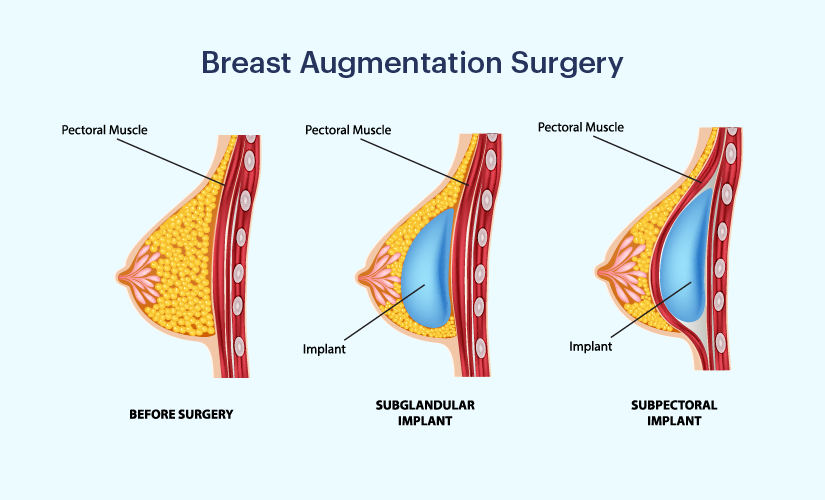
Another important discussion with your Breast Augmentation Surgeon involves implant placement. Depending on your anatomy and surgical plan, implants may be placed in different positions relative to the breast tissue and chest muscle.
The appropriate placement depends on factors such as your existing breast tissue, body structure, implant type and desired result.
Ask your surgeon:
- Where will the implant be positioned?
- Why is this placement appropriate for me?
- How will placement affect the final appearance?
- Could placement affect future mammograms?
- What are the advantages and disadvantages of each option?
A qualified Breast Augmentation Surgeon should explain these choices in language you can understand.
Pay Attention to the Consultation
Your consultation is one of the best opportunities to evaluate a Breast Augmentation Surgeon. ASPS explains that the consultation can involve photographs, discussion of treatment options, expected outcomes and possible risks or complications.
A good consultation should feel like a two-way conversation. You should have enough time to describe your goals, ask questions and understand the recommended procedure.
A Good Surgeon Should Listen
Your Breast Augmentation Surgeon should ask about:
- Your desired breast size
- Your preferred appearance
- Previous breast surgery
- Pregnancy history
- Breastfeeding history
- Medical conditions
- Previous complications
- Medications
- Allergies
- Future pregnancy plans
- Your expectations about recovery
You should feel comfortable discussing concerns about your body and the surgery.
Ask About Surgical Facility Accreditation
The quality and safety of the surgical facility are important when choosing a Breast Augmentation Surgeon. ASPS recommends that breast augmentation be performed in an accredited outpatient or ambulatory surgical centre or a hospital.
Ask where the operation will take place and whether the facility is accredited, state licensed or otherwise appropriately certified.
Questions About the Facility
Ask your Breast Augmentation Surgeon:
- Where will my surgery take place?
- Is the facility accredited?
- Is it state licensed?
- Who provides anaesthesia?
- What happens if an emergency occurs?
- Will I go home the same day?
- Who will monitor me after surgery?
These questions can help you understand the complete surgical environment rather than focusing only on the surgeon's office.
Understand the Total Breast Augmentation Cost
Cost is naturally an important factor when choosing a Breast Augmentation Surgeon, but the cheapest quote should not automatically be considered the best option.
The total cost may include:
- Surgeon fee
- Implant cost
- Anaesthesia
- Surgical facility
- Pre-operative testing
- Prescription medicines
- Post-operative garments
- Follow-up appointments
- Additional treatment if complications occur
A low advertised price may not include all of these expenses.
Compare Complete Quotes
When comparing a Breast Augmentation Surgeon, ask each practice for a written estimate that clearly explains what is included.
Instead of asking only, “How much does breast augmentation cost?” ask:
“What is my complete estimated out-of-pocket cost, including the surgeon, implant, anaesthesia, facility and routine follow-up?”
This makes it easier to compare different practices fairly.
Ask About Complications and Reoperations
A trustworthy Breast Augmentation Surgeon should be willing to discuss complications openly. Avoid a consultation where the surgeon makes the procedure sound completely risk-free.
The FDA lists complications and adverse outcomes associated with breast implants, including capsular contracture, reoperation, implant removal, rupture or deflation, wrinkling, asymmetry, scarring, pain and infection.
Ask your surgeon about their own complication and reoperation experience.
Important Questions
Ask:
- What complications do you see most often?
- What is your infection rate?
- How often do patients require additional surgery?
- What happens if an implant ruptures?
- What happens if I develop capsular contracture?
- Who pays for treatment if a complication occurs?
- What happens if I am unhappy with the result?
The goal is not to find a surgeon who claims to have zero complications. Instead, look for a Breast Augmentation Surgeon who communicates honestly about risks and has a clear plan for managing complications.
Understand That Breast Implants Are Not Lifetime Devices
One of the most important things to discuss with your Breast Augmentation Surgeon is the long-term nature of implants.
The FDA states that breast implants are not lifetime devices. Over time, the possibility of complications can increase, and some patients may require additional surgery for implant removal, replacement or treatment of complications.
This means breast augmentation should be considered a long-term medical decision rather than a one-time cosmetic purchase.
Your surgeon should explain how your implants will be monitored and what signs or symptoms should prompt medical evaluation.
Ask About Breast Implant Monitoring
Your Breast Augmentation Surgeon should explain how you will monitor your implants after surgery.
The FDA states that patients with silicone gel-filled implants may be advised to undergo MRI or ultrasound monitoring for silent rupture, and these examinations may not always be covered by insurance.
Ask:
- Will I need future imaging?
- When should monitoring begin?
- How frequently should imaging be performed?
- Will my insurance cover it?
- What symptoms should I report?
- How will the implant be monitored during routine breast screening?
Understanding long-term monitoring before surgery can help you make a more informed decision.
Discuss BIA-ALCL and Other Implant Risks
A responsible Breast Augmentation Surgeon should discuss the risks associated with breast implants, including breast implant-associated anaplastic large cell lymphoma, known as BIA-ALCL.
The FDA has identified an association between breast implants and BIA-ALCL, a type of non-Hodgkin lymphoma that can develop in fluid or scar tissue surrounding an implant. The FDA also notes that BIA-ALCL occurs more commonly with textured implants than smooth implants.
This does not mean that every patient with an implant will develop BIA-ALCL. However, patients should understand the potential risk and discuss implant surface characteristics with their surgeon.
If you develop persistent swelling, pain or other unusual changes around an implant, contact your healthcare provider. The FDA recommends evaluation when symptoms potentially associated with BIA-ALCL occur.
Evaluate the Surgeon's Communication Style
Your relationship with your Breast Augmentation Surgeon does not end when the operation is finished. Follow-up care is an important part of the surgical experience.
Choose a surgeon who clearly explains what will happen before, during and after surgery.
A good surgeon should explain:
- How to prepare
- What to expect on surgery day
- Pain management
- Sleeping position
- Activity restrictions
- Wound care
- Follow-up appointments
- Warning signs
- When you can return to work
- When you can exercise
- How long swelling may last
The FDA specifically recommends considering patient follow-up and your comfort level with the surgeon when choosing a breast implant surgeon.
Don't Choose a Surgeon Based Only on Social Media
Social media can be useful for learning about a Breast Augmentation Surgeon, but it should not be your primary method of evaluating qualifications.
Instagram and other platforms can show attractive photographs, testimonials and promotional content, but they do not necessarily provide complete information about training, certification, complications or long-term patient care.
Use social media as a starting point, then verify credentials independently.
Be Careful With Promotional Claims
Be cautious about statements such as:
- “Best breast surgeon in America”
- “Guaranteed perfect results”
- “No-risk breast augmentation”
- “Permanent implants”
- “Cheapest breast augmentation”
- “Zero recovery time”
No ethical surgeon can guarantee that every patient will have a perfect result.
A qualified Breast Augmentation Surgeon should discuss realistic outcomes and possible complications rather than making unrealistic promises.
Compare at Least Two or Three Surgeons
Meeting more than one Breast Augmentation Surgeon can help you compare recommendations.
You may find that different surgeons recommend different implant sizes, profiles or placement techniques. This does not necessarily mean one surgeon is wrong. Breast augmentation can involve several reasonable approaches depending on your anatomy and goals.
During consultations, compare:
| Factor | What to Compare |
|---|---|
| Certification | ABPS certification and training |
| Experience | Number of breast procedures performed |
| Before & after photos | Similar patients and consistent results |
| Facility | Accredited, licensed or certified setting |
| Implant options | Silicone and saline choices |
| Communication | Clear and realistic explanations |
| Cost | Complete written estimate |
| Follow-up | Post-operative care plan |
| Safety | Complication and reoperation discussion |
| Long-term care | Implant monitoring and future surgery |
This comparison can make your decision more objective.
Prepare for Your Breast Augmentation Consultation
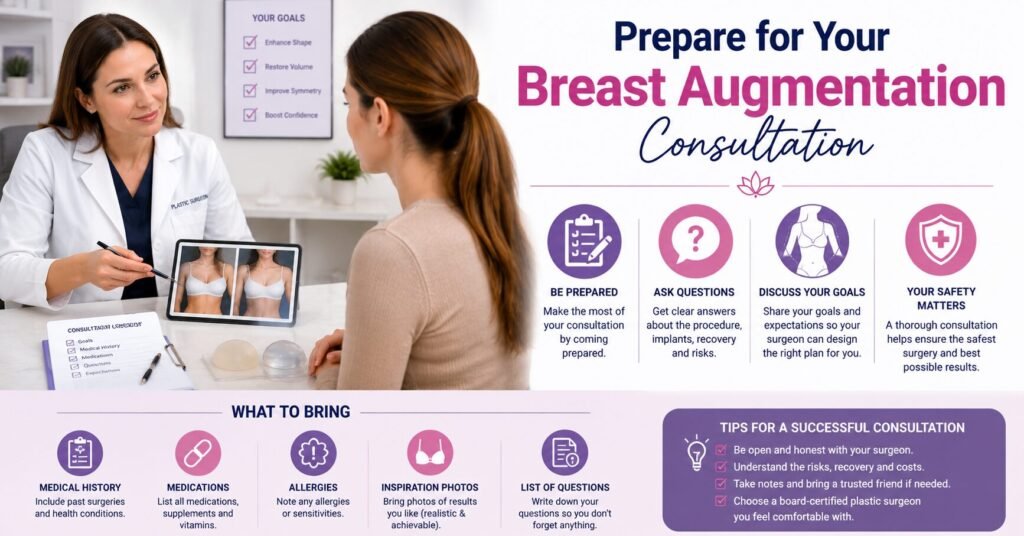
Before meeting a Breast Augmentation Surgeon, write down your questions. Patients sometimes forget important questions during a consultation because there is a lot of information to process.
Bring a list of medications, supplements, allergies and previous surgical information.
ASPS notes that preparation may include blood testing, medication adjustments and stopping smoking, while aspirin and certain anti-inflammatory medicines may need to be avoided because they can increase bleeding risk. These decisions should always be made according to your surgeon's instructions.
You should also tell your surgeon about previous surgeries and how your body responded to them.
Questions to Ask the Best Breast Augmentation Surgeon
Before choosing your Breast Augmentation Surgeon, consider asking these questions:
- Are you certified by the American Board of Plastic Surgery?
- How many breast augmentation procedures do you perform each year?
- How much of your practice is focused on breast surgery?
- Which implants do you recommend for me?
- Why do you recommend that implant?
- What implant placement do you recommend?
- What incision location do you recommend?
- What complications do you see most often?
- What is your reoperation rate?
- Where will my surgery take place?
- Is the facility accredited?
- Who will provide my anaesthesia?
- What is the complete cost?
- What happens if I develop a complication?
- How long will recovery take?
- When can I return to work?
- When can I exercise?
- What follow-up appointments are included?
- What long-term implant monitoring will I need?
- What should I do if I am unhappy with my result?
ASPS provides a similar consultation checklist covering board certification, training, hospital privileges and facility accreditation.
Red Flags When Choosing a Breast Augmentation Surgeon
Knowing what to avoid can be just as useful as knowing what to look for in a Breast Augmentation Surgeon.
Consider seeking another opinion if a surgeon:
- Refuses to discuss board certification
- Cannot clearly explain their plastic surgery training
- Pressures you to schedule immediately
- Promises a guaranteed result
- Avoids discussing complications
- Cannot provide a complete cost estimate
- Performs surgery in an unsuitable facility
- Discourages questions
- Recommends implants without explaining why
- Makes unrealistic claims about implant longevity
- Focuses heavily on price rather than safety
- Does not explain follow-up care
A professional consultation should give you enough information to make a considered decision.
What Makes the Best Breast Augmentation Surgeon?
The “best” Breast Augmentation Surgeon is not necessarily the most famous surgeon or the surgeon with the highest online rating. The best surgeon for you should have appropriate credentials, relevant experience, a strong safety focus and an approach that matches your goals.
Look for a surgeon who combines technical skill with careful patient communication. The surgeon should understand that breast augmentation is individual and should create a treatment plan based on your body rather than applying the same approach to every patient.
A good Breast Augmentation Surgeon should also be comfortable saying when a particular implant size or procedure is not appropriate for your anatomy.
Final Checklist Before Choosing Your Surgeon
Before booking breast augmentation, use this simple checklist:
Credentials
- Verify ABPS board certification.
- Confirm specialised plastic surgery training.
- Check medical licensing.
Experience
- Ask how many breast augmentations the surgeon performs.
- Review relevant before-and-after photographs.
- Ask about revision surgery experience.
Safety
- Confirm the surgical facility is appropriately accredited or licensed.
- Ask about anaesthesia.
- Discuss complications and reoperation rates.
Implants
- Understand silicone and saline options.
- Discuss implant size and shape.
- Ask about surface texture and placement.
- Read the FDA-required patient information.
Cost
- Request a complete written estimate.
- Confirm whether anaesthesia is included.
- Confirm facility charges.
- Ask about follow-up costs.
- Understand potential future expenses.
Long-Term Care
- Ask how implants will be monitored.
- Understand possible future surgery.
- Keep your implant device information after surgery.
The FDA requires breast implant labelling that includes a boxed warning and patient decision checklist. Patients should have an opportunity to review this information with their healthcare provider before proceeding.
Must Read:
- Frozen Embryo Transfer: Cost, Procedure, Success Rates & Recovery
- IVF Treatment Cost in the USA: What You Need to Know in 2026
- Top 5 Best Iron Supplement For Pregnancy
Final Thoughts:
Choosing the right Breast Augmentation Surgeon in the USA requires more research than simply searching for the lowest price or the most impressive social media profile. Board certification, specialised training, breast surgery experience, facility standards, implant knowledge, communication and long-term follow-up should all be part of your decision.
Start by verifying whether the Breast Augmentation Surgeon is certified by the American Board of Plastic Surgery. ASPS recommends board-certified plastic surgeons and highlights the importance of appropriate surgical training and accredited, state-licensed or Medicare-certified facilities.
Next, evaluate the surgeon's breast augmentation experience. Ask how many procedures they perform, what implants they use, their complication and reoperation experience and how they approach different patient anatomies. The FDA specifically recommends asking about surgeon experience, board certification, patient follow-up and the types of breast implants used.
Your consultation is also an important test of the surgeon-patient relationship. The right Breast Augmentation Surgeon should listen to your goals, explain your options, discuss realistic expectations and give you enough information to make an informed decision.
Finally, remember that breast implants require long-term consideration. The FDA states that implants are not lifetime devices and that additional surgery may eventually be necessary. Patients should understand potential complications, monitoring requirements and the possibility of future implant removal or replacement before deciding to proceed.
The safest approach is to compare qualified surgeons rather than choosing the first provider you find. Take your time, ask detailed questions, review your options and make sure you feel comfortable with the surgeon and the proposed treatment plan.
Medical Disclaimer: This article is for general educational purposes and does not replace medical advice, diagnosis or treatment. Breast augmentation is a surgical procedure with individual risks and benefits. Speak with a qualified, board-certified plastic surgeon about your personal medical history, implant options, expected results and potential complications before making a decision.